

How to Pitch a Business Idea in 5 Minutes
To pitch a business idea in five minutes, name the customer and problem, explain the solution, show one workflow, separate evidence from assumptions, explain the business, and ask for one next step. Rehearse against a timer; six slides can support that sequence, but the event's rules come first.
9 min read · By Axiom Lab · Published · Updated

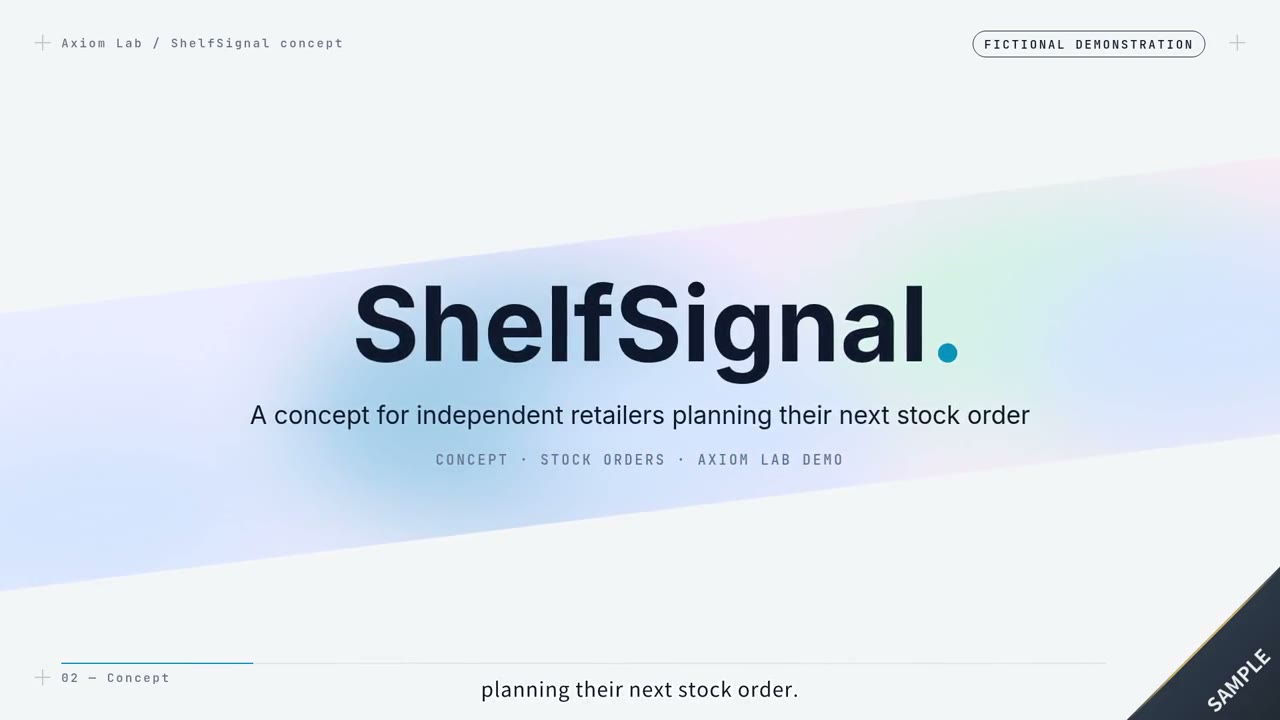
Watch a complete demonstration
A fictional inventory-planning product, introduced through the problem, workflow and a pilot request.
Fictional demo · Film, input and script ↗Who is in the room
This is a live presentation to someone deciding whether to explore your business: an investor, an accelerator panel or a potential pilot partner. Choose one of those audiences before writing. A pilot customer needs scope and implementation details; an investor also needs a credible market, business model, team and funding use.
The six suggested slots below total five minutes and assume questions happen afterward. If the entire slot includes Q&A, agree a shorter presentation first. The example is material to adapt and rehearse, not a recording measured at exactly five minutes. This live-pitch guide does not describe a five-minute Axiom Lab video: the current project-video range is 30–180 seconds.
[Business] helps [specific customer] do [important job]. We have [honest evidence], and want [one decision] so we can test [next milestone].
| Format | Duration | Best use & goal |
|---|---|---|
| Elevator pitch | 30s (~65–75 words) | First introduction or referral; name the problem and earn a follow-up conversation. |
| Async pitch video | 60–90s (product range: 30–180s) | Sent before a meeting; stands on its own with problem, solution, proof and dated request. |
| Live deck pitch | 5-min live talk + Q&A | Demo Day or formal review; cover unit economics, assumptions, risks and live questions. |
What to say, in order
- Customer and problem0:00–0:40 · 40 seconds
- Solution and difference0:40–1:30 · 50 seconds
- One product workflow1:30–2:15 · 45 seconds
- Evidence and open questions2:15–3:05 · 50 seconds
- Business and delivery3:05–4:10 · 65 seconds
- One ask and a stopping point4:10–5:00 · 50 seconds
Customer and problem
Say what the business does, then describe one customer's task and the current workaround. Use an observation you can explain. If the story is hypothetical, label it. Put the customer and situation on slide one, rather than a broad slogan.
Solution and difference
Explain what changes for that customer. Name the alternative they already use and the specific difference you propose. Avoid claiming every competitor is worse. A simple before-and-after diagram can carry slide two.
One product workflow
Walk from an input to an action to a result. Use a reliable recording or three screenshots if a live demo is fragile. Say whether the screens are live software, a prototype or a concept. Keep a still-image fallback.
Evidence and open questions
Present one or two facts with their dates, denominators and sources. Separate paid use from interviews and expressions of interest. At idea stage, describe a proposed test and its success condition instead of inventing traction.
Business and delivery
Identify the buyer, how you expect to charge, the initial reachable market and why the team can deliver. Mark pricing and market estimates as assumptions. For a client audience, use this time for pilot scope, ownership and implementation costs.
One ask and a stopping point
State the decision, who needs to make it, what it enables and the proposed date. An investor ask can include an amount and milestone; a pilot ask can name scope and an evaluation meeting. End with time to spare instead of starting a new feature list.
Make the explanation concrete
ILLUSTRATIVE REWRITE
Before
Five minutes of background, followed by a rushed request.
After
Introduce the problem, show the product, explain the evidence and leave time for one request.
Give the audience the argument early enough to understand the closing decision.
Fill the brackets
If a bracket has a missing fact, cut the sentence. Do not invent a number to make the line sound finished.
- Opening
[Name] helps [customer] [job]. Today they [workaround]. We observed [specific evidence], which suggests [problem worth testing].
- Solution
Our proposed change is [one sentence]. Compared with [alternative], we focus on [difference]. Here is where that matters: [one situation].
- Demonstration
The user starts with [input], does [action], and sees [output]. This is [a concept / prototype / available product]. [Person] remains responsible for [decision].
- Evidence
As of [date], we have [fact and source]. This supports [limited conclusion]; it does not yet establish [open question]. Our next test is [method and success condition].
- Business
The buyer is [role]. We expect to charge [model], which is [validated / still an assumption]. We can reach [initial segment] through [channel]. Our relevant experience is [verifiable experience], and the missing capability is [gap].
- Ask
We are asking for [specific decision] by [proposed date]. That would let us reach [milestone]. We would evaluate it using [measure] and stop or revise the plan if [condition].
Worked example: a pilot pitch for ShelfSignal
Fictional teaching example. ShelfSignal is not a customer or a validated business. The following is an adaptable rehearsal draft; its timing depends on delivery and demonstration pauses. No revenue, customers or measured savings are claimed.
ShelfSignal is a concept for independent retailers preparing their next stock order. Imagine a buyer with a sales export, a supplier email and a separate stock count. The decision is not simply what sold last week. It is what to order now, given the stock on hand and the supplier's constraints. In this example, those inputs sit in different places. We want to learn whether bringing them into one review would help the buyer make a more traceable decision.
The proposed product combines the inputs into a draft order that the buyer can inspect. The starting alternative is the retailer's existing spreadsheet and judgment, not an assumption that they have no process. Our proposed difference is visibility: the buyer can see the data and assumptions behind a suggestion before accepting it. We are not claiming to forecast demand perfectly or to replace the person accountable for buying stock.
Here is the workflow we would demonstrate. First, the buyer imports a sales file. Next, the review shows a suggested order alongside its assumptions. Finally, the buyer changes or approves the quantities before anything is sent. These are concept steps, not evidence that a working integration exists. A prototype demonstration would need to show what happens when a stock count is missing or the supplier changes an order minimum. Those exceptions belong in the test.
There are no customers or revenue figures in this demonstration. The evidence we want next is a comparison between the draft recommendation and the buyer's own decision, with the reasons for changes recorded. Before a pilot, both sides would agree what data can be used, which decisions remain manual and what would make the review useful. If the buyer cannot understand why a recommendation was made, we would treat that as a problem to fix rather than a successful automation.
The potential buyer is an owner or purchasing lead at an independent retailer. A subscription might be a business model, but willingness to pay and support costs are untested assumptions. We would start with one store and one category so the learning has a clear boundary. A real team would also need to explain its retail experience, data handling and implementation capacity. This fictional example supplies no invented credentials. Those gaps would have to be addressed before committing to delivery.
Today, the request is a pilot-design conversation, not a purchase order or investment commitment. We would ask a purchasing lead to walk through one recent ordering decision and help define a limited test. At the end of that discussion, we would agree a review date, an owner and the conditions for proceeding. If the process creates more unexplained work than it removes, we would revise the approach. The next step is to decide whether that small, reviewable test is worth designing together.
What to have ready
Confirm the actual slot
Make a claim ledger
Rehearse with the real transitions
Prepare three follow-up answers
Turn the live presentation into a useful follow-up
Keep the full presentation for the meeting. For an asynchronous introduction, choose the problem, one workflow, your strongest supported fact and the same ask. A short summary should identify what the viewer will find in the linked deck; it need not reproduce every slide.
Our public ShelfSignal film is a 74-second fictional explainer made from a text brief. It illustrates the same concept, not a five-minute performance or a test of a real retailer. Use the brief and transcript to compare what stays in a short version and what belongs in the live discussion.
Where it goes wrong
Changing the audience halfway through
Calling interviews traction
Using the clock as a word target
Finishing with only a thank-you
Make it a film
Once the live pitch is clear, prepare a shorter video brief for people who want an introduction before the meeting. Preserve the evidence limits and keep one next step.
A project video runs about a minute, in three chapters: the painful situation, the solution, and the advantages. You submit the name, the audience, the situation, the solution, how it works, the evidence and the next step, and you can upload a plan, a deck, a PDF or photos. Select Start to analyse the material. On the film page, review the suggested length and select Confirm and start to proceed. Do not include a result you cannot source. A film is delivered only after it passes checks, and charged only once delivered.
During the beta, a new address needs an invite code. If you do not have one, write to sales and ask for access.
FAQ
How many slides should a five-minute business pitch have?
Six slides are a workable starting point for the six sections above, not a rule. Follow the event's limit, keep each slide to one job and move detailed evidence into backup material.
What if I have an idea but no customers?
Name the stage honestly. Show what you observed, what remains an assumption and the smallest test that could change your mind. Do not invent users, revenue or testimonials to fill a traction slide.
Can I use this for a consulting pitch?
Yes. Replace market and fundraising detail with the client's decision, a limited scope, delivery responsibilities, a proposed fee or quoting process, and an evaluation point. Use only client material you have permission to share.
Can Axiom Lab generate the complete five-minute presentation?
This guide covers a live five-minute pitch. The current project-video range is 30–180 seconds. You can use a shorter summary for follow-up; do not submit the full five-minute script expecting a five-minute film.
Sources and editorial notes
- Y Combinator · How to Pitch Your Company
Clear explanations of the product, progress, business model and request.
- Sequoia Capital · Writing a Business Plan
Questions to cover when explaining a business, including the customer problem and alternatives.
These references provide related principles. The sequence, timings and fill-in scripts on this page are Axiom Lab's editorial suggestions, not endorsements by those organizations or measured fundraising or sales results. Adapt them to the audience's requirements and replace placeholders with verifiable facts.
Our public demonstrations use fictional projects and include their actual inputs and transcripts; they are not customer evidence. View the production notes · Editorial and corrections policy